I end up with one complete bundle (all files are ready),
but my scenario keeps triggering multiple times for the same order.
What happens:
First, 2 files are created by scenario A
Then another 2 files by scenario B
Later, suddenly 18 files
while I only want 1 final output file per order
It seems that Make treats every new file or update as a new trigger, even though all files belong to the same order and the same logical bundle.
Question:
How can I prevent a scenario from being triggered multiple times for the same order,
and ensure that exactly one output file is created per order?
I’m looking for a structural solution (deduplication, locking, status flags, trigger configuration, or best practices).
It’s hard to say from the description alone.
If you could share some screenshots, it might help.
But just as an assumption of things that could be doing this kind of things:
If it’s a webhook, you might have items in the queue that didn’t execute earlier.
It could be related to what actually triggers the automation
You probably did not aggregate a module that could possibly output more than one bundle, or did not select the correct source module.
Combining Bundles Using Aggregators
Every result/item from some module types (like Trigger / Iterator / List / Search / Match modules) can potentially and likely output more than one bundle. These multiple bundles will individually run subsequent modules once per bundle, which is not optimal in most cases:
one operation per bundle per module, which could lead to…
use of multiple credits per bundle per module (some modules use more than one credit)
View example screenshots
Aggregator Example
The “Search Rows” module runs one time, returning 999 results (999 bundles).
Without Aggregator: the tools module run 999 times (999 operations)
This can easily use your entire quota of credits if you are not careful or fail to understand this concept.
To “combine” multiple bundles into a single variable, so that you can process all of the items in a single operation, you’ll need to use an aggregator. Aggregators is a type of module that accumulates bundles and outputs one bundle (unless you are using “Group By”). An example of a commonly-used aggregator module is the Array aggregator module.
You can find out more about some other aggregator modules here:
Question: Which is the best aggregator do you think you’ll need for your use-case?
Setting the Correct Aggregator Source
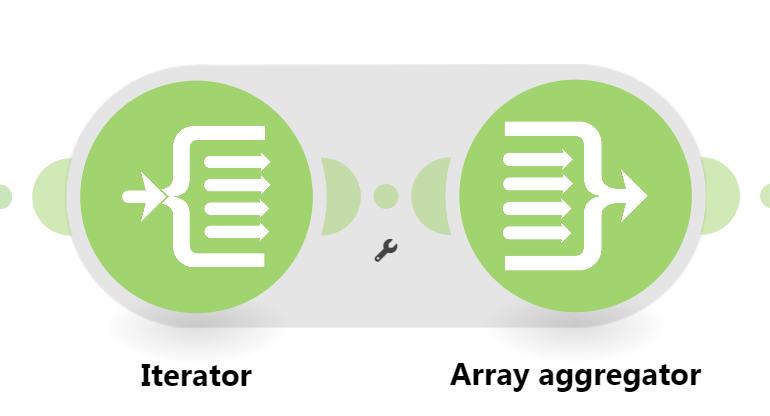
You need to set the “Source Module” field of the aggregator to where the bundles are coming from. This is usually an iterator module, but can also be a search/list/repeater module, or even the trigger module!
Here is an example of how your scenario could look like: This is just an example. Your solution may or may not look like this depending on requirements and actual data.
 What is your goal?