I am trying to use the Vonage integration, the “Update a Call” node specifically.
What is the problem & what have you tried?
I’ve tried like 5 or 10 times but it gives me: “The operation failed with an error. Validation failed for 2 parameter(s).” no matter what I do. I tried to configure the node in all the different options, mapped and non-mapped. It’s like the node isn’t reading the values I’m giving it.
Error messages or input/output bundles
“The operation failed with an error. Validation failed for 2 parameter(s).”
You cannot individually run a single module if you don’t have example input data values for each required field, which you must input into the dialog box when you manually run a single module. This is because when you run a module directly, the mapped variables in the fields are null (do not contain any value).
Instead, try running the full scenario by clicking the “Run Once” button:
For more information, see these duplicate questions previously asked and answered by other community members:
Thanks for the help! I tried this before posting. But it doesn’t matter how I configure the module, I get the same error “Invalid collection in parameter ‘ncco’.”
It’s as if the module acts like I didn’t pick the ncco option and fill out the details. But I’ve tried over and over to make sure its all enabled in the UI.
It seems that the NCCO field expects a mapped ARRAY variable of collections.
You are inserting a STRING of plain text.
If you want to use the “MAP” toggle, you are required to build an ARRAY of collections using Make Variables and Data Structures, not manually type in a string like that.
For more information, see below.
Combining Bundles Using Aggregators
Every result (item/record) from trigger/iterator/list/search/match modules will output a bundle. This can result in multiple bundles, which then trigger multiple operations in future modules (one operation per bundle). To “combine” multiple bundles into a single variable, you’ll need to use an aggregator of some sort.
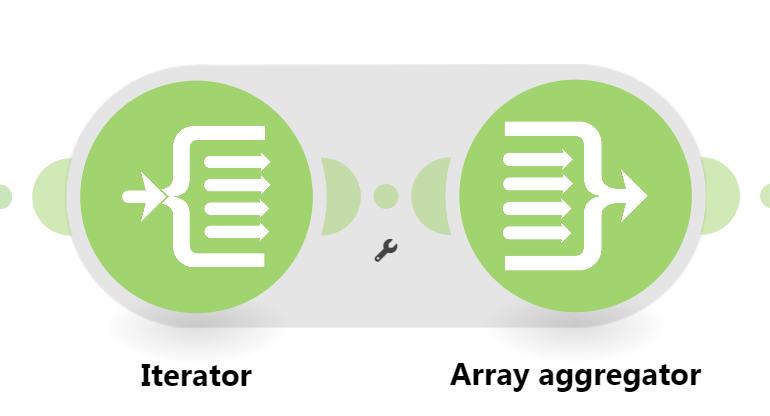
Aggregators are modules that accumulate multiple bundles into one single bundle. An example of a commonly-used aggregator module is the Array aggregator module. The next popular aggregator is the Text Aggregator which is very flexible and can apply to many use-cases like building of JSON, CSV, HTML.
You can find out more about the other types of aggregator modules here:
Question: Which is the best aggregator do you think you’ll need for your use-case?
Mapping a Specific Structure Into a Complex Field
If you have an array of collections, in programming terms, this is called an array of objects (collections), or an array with non-primitive data types (“complex array”).
The Array Aggregator module is very powerful because it allows you to build a new complex array of collections that matches a later module’s field to map multiple items (collections) to it. Such fields initially would allow you to manually add items, but you can toggle the “Map” switch to the “on” state and map a whole array into a single field.
This is done by selecting the “Target structure type” in an Array Aggregator module.
As you can see from the above example, the “Map” toggle on complex fields are used when you have an array variable (like from an array aggregator). Other combinations of modules may also allow you to generate an array that matches a future field’s array structure, like “Aggregate to JSON + Parse JSON”, or “Create JSON + Parse JSON”, but this is an advanced topic.
Question: Are you mapping your array into a field that accepts more than one item/collection?
Example
Here is an example of how your scenario could look like:
This is just an example. Your final solution may or may not look like this depending on your requirements and actual data.
 What is your goal?
 What is the problem & what have you tried?
 Error messages or input/output bundles
 Screenshots (scenario flow, module settings, errors)